

Industrial flooring, a prefabricated flooring with polymer resin materials and fiber cloth or mesh as the main components, is widely used in industrial manufacturing environments. Its excellent corrosion resistance, easy cleaning properties, no dust generation, excellent chemical corrosion resistance and high wear resistance make industrial flooring an ideal choice for the industrial field.
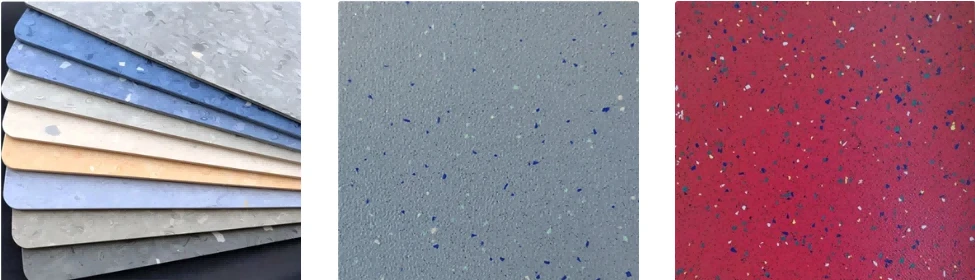
Construction and paving of industrial flooring
In industrial environments, the construction and paving of industrial flooring is a crucial link. Through a scientific and reasonable paving system, the stability, durability and performance of the floor can be fully utilized.
Detailed explanation of the construction process:
First, conduct a comprehensive inspection of the base layer and carry out necessary repairs and finishing work. Next, pre-lay the industrial floor, determine the size modulus and cut it. Then, apply glue and let it air dry (note that two-component polyurethane does not need to be air-dried). After that, officially lay the industrial floor, use cork boards to push to eliminate bubbles, and then use iron rollers to roll to ensure firmness. After 48 hours, the grooves are cut and the welds are treated with polymer resin. Finally, the welds are leveled with a trowel and thoroughly cleaned and protected.
Detailed explanation of construction points:
The ground foundation must be kept dry, the moisture content is strictly controlled within 4%, and a moisture-proof layer must be set up on the first floor.
The compressive strength of the ground foundation should reach 25MPa or above. For heavy load areas and special function bases, additional requirements are required. In heavy load areas, the pull-out strength must be ≥5MPa; in light load areas, the pull-out strength must be ≥0MPa.
The flatness of the foundation ground should be tested with a 2m ruler to ensure that the flatness is ≤2mm.
The foundation ground must be clean and free of pollutants such as oil, isolation, etc.
The ground must not have problems such as sanding, cracks, hollowing or damage. If there is a problem with the base, it must be professionally treated and accepted before construction can be carried out.
The air humidity during the construction of industrial flooring should be controlled between 35% and 75%, and the construction environment temperature should be maintained at 10℃~30℃.
When laying and installing industrial flooring, it is not recommended to perform secondary leveling treatment on the base layer in principle. Heavy-duty grinders can be used for longitudinal and transverse grinding to improve the smoothness of the ground. If the flatness and smoothness of the base layer are poor and secondary leveling treatment is indeed required, self-leveling materials that meet specific technical indicators should be selected.
Regarding gap treatment, including cut expansion joints, irregular cracks, and construction cold joints, all need to be properly handled. Specifically, it is necessary to cut the depth and width along the crack, and cross the crack at 90° to cut a horizontal pull joint with a length of about 12cm, and the spacing is controlled at 200-300mm. After that, use a high-pressure air gun to blow away the dust in the gap, add corrugated steel sheets and inject epoxy resin for repair. After the repair is completed, it is necessary to wait for 24 hours before the next process construction.
Industrial flooring installation process
Material preparation and pre-laying
The industrial flooring is transported to the construction site to ensure that the unrolling and curing time is not less than 48 hours. According to the flooring laying specifications and the actual situation on site, the flooring is accurately measured and cut. The cutting work must be done by professionals, and at least 20mm of margin must be reserved according to the measurement data.
Lay the floor according to the design plan, and use a marker to carefully mark along the edge of the floor to ensure that the floor position is accurate during the laying process. The overlapping method is used for flooring, and the width of the overlapping part should be greater than 20mm.
Glue scraping
When lifting the floor, it is necessary to maintain balance to avoid skew; at the same time, ensure that the floor rolls at a moderate amplitude to prevent creases. Debris or sand on the back of the floor should be removed in time to ensure the laying quality.
Refer to the ratio of M919 two-component polyurethane floor glue for mixing and accurate weighing. Use A3 or B3 toothed scraper for glue scraping construction, and control the glue amount to about 400-450g/㎡. It is worth noting that the M919 two-component polyurethane adhesive does not need to be dried deliberately. The next step can be carried out after the floor is laid to avoid the curing of the glue affecting the adhesion of the floor.
Use an electric mixer to fully stir the weighed glue, and the stirring time is controlled within 2min3min to ensure that the glue is uniform. Then, evenly scrape the stirred glue on the floor surface to be laid, and pay attention to the uniformity of the scraping glue to avoid problems such as uneven surface, obvious scratch marks or local false adhesion after the floor is laid.
After scraping the industrial floor adhesive, the glue needs to be dried for 10min30min. After the drying is completed, touch the glue with your fingers. If there is a wire drawing phenomenon, the floor can be laid (the specific drying time needs to be determined according to the construction environment).
Floor laying
Push the lifted floor in place along the reference line to ensure that the laying is reset; during the laying process, it is necessary to prevent the roll material from offset or dislocation, and at the same time ensure that the floor at the joint can overlap smoothly for joint cutting.
After the floor is pasted, use a cork block to gently push the floor surface, push in a fan shape to squeeze out the air, so that the floor and the adhesive are fully in contact. Then, use a 50kg or 75kg steel roller to roll the floor to ensure that the floor and the base can be tightly combined.
Do not roll the floor temporarily at the position where the floor is superimposed 20cm to reserve enough space for joint cutting operations. For floors covered with walls and corners, use a small steel roller or hand to fully push to ensure a tight fit. At the same time, wipe off the glue squeezed out of the floor surface in time.
Use joint cutting tools (such as manual push knives, guide rail push knives, etc.) to cut from the middle of the floor superposition position to ensure that the edges of the two rolls can be seamlessly spliced. The splicing and trimming work must be completed before the glue hardens to avoid the problem of loose edge adhesion or warping. It is best to cut it with one knife and compact it again at the edge of the gap. If it is found that there is a local warping edge or the skirt cannot be glued, a hot air gun can be used for treatment; if the local problem is serious, heavy objects can be used for long-term pressure.
Grooving
The groove work should be carried out after the glue is completely cured to ensure the stability of the welding. A special groover is an essential tool. Fine grooves are made along the joints, but be careful not to penetrate the bottom. The recommended groove depth is 2/3 of the floor thickness.
At the end position that the groover cannot reach, a manual groover can be used to make grooves with the same depth and width. Before welding, be sure to remove the dust and debris remaining in the groove to ensure the quality of welding.
The cold welding process is: groove → paste masking paper edge protection → prepare caulking agent → fine caulking → scrape the seam, and then tear off the masking paper.
For hot welding, you need to choose suitable tools, such as manual welding guns or automatic welding equipment, and adjust the welding gun temperature to about 350℃-450℃. Maintain an appropriate speed and proceed at a uniform speed during welding. When the electrode is half-cooled, cut off the main part above the ground, and after the electrode is completely cooled, cut off the remaining part above the ground.
Seamless connection is an important part of industrial floor laying. According to the pre-laying plan, two adjacent floors are directly spliced, and the joints are ensured to be tight and straight.
Delivery
When using the cold welding process, the residual caulking agent on the surface of the roll should be carefully wiped off before the caulking agent is completely cured.
After all the laying work is completed, the site should be thoroughly cleaned up, including removing garbage and cutting waste, and ensuring that they are properly transported to the designated landfill.
Carry out a comprehensive self-inspection of the laid industrial floor to promptly discover and deal with existing problems. It can only be officially delivered for use after acceptance and confirmation by the relevant parties.
Acceptance
Material requirements
The materials used for industrial floors must strictly comply with the design requirements and contract regulations in terms of variety, color, specification and thickness. In terms of color, there should be no color difference when observed by the naked eye; in terms of thickness, no deviation is allowed.
For the roll material, we will ensure that there are no cracks, wrinkles, or swirls on the surface under naked eye observation to ensure its integrity.
The surface of the floor must be kept clean, without any foreign matter and impurity particles, and the size must strictly meet the specifications at the time of leaving the factory.
In addition, the bonding between the surface layer and the next layer is also one of the important acceptance criteria. It must be ensured that the bonding is firm, without warping, degumming or overflowing.
Quality requirements for paving completion
After the industrial floor is laid, its surface layer should be kept clean, without creases or scratches, and the joints should be tight. The joints should be smooth and without glue marks. When it meets the wall, it should be natural and tight, and the corners should be square, straight and smooth.
The welding seams of the floor must be flat and smooth, without defects such as coking discoloration, spots, weld nodules or scaling. Its height deviation shall not exceed 6mm.
The size of the material used for pressing the edge must be accurate, the edges and corners must be neat, the joints must be tight, and the joints should be straight.
The combination of the floor and the base floor must be firm, and there must be no bulging, hollowing, degumming or warping.
The allowable deviation of industrial floor after laying is: surface flatness is controlled within 3mm/2m, seam straightness deviation is 3mm, and seam height difference does not exceed 5mm.
