
There are two words that are important to understand: heterogeneous and homogeneous. They define the construction structure that plays a role in where and how the product is used.
Heterogeneous means layered or multiple types. In this type of product, each layer looks a little different. There is a backing layer, a coated core layer, and a wear layer. To help with memory, imagine a hamburger or layer cake. When you look at it from the top, it looks like one thing, but when you cut it open and look at the cross-section, you see multiple different layers, each of which has a different purpose.
Homogeneous, on the other hand, means a single layer or all made of the same substance. It looks the same from the top, the middle, and the bottom. Going back to the food analogy, think of a steak or potato. It looks the same from the top or the bottom, and even if you cut it open, it looks the same throughout.
Heterogeneous Construction
Multi-layer products require a multi-step manufacturing process. We start with a carrier product. For most heterogeneous commercial products, the carrier product is usually fiberglass. We then apply a liquid coating with a roller. This coating can be applied to the top, back, or like most Mannington commercial products, both the top and bottom.
After the liquid coating is applied, the material goes through an oven that cures the vinyl coating on both sides of the fiberglass. This process builds the core layer of the product and creates a canvas for the printed visual design.
Next comes the rotogravure printing process. Rotogravure printing is a fairly complex printing process. The process gives the product a unique visual effect, and this visual effect is created by our design department. Inspired by natural wood, tile, weaving, and even abstract looks, each pattern is divided into different elements to create a visual hierarchy. Each visual hierarchy is then engraved on the rollers used in the printing process.
The vinyl sheet produced in the pre-gel process described earlier passes between an impression roller and a print roller. The impression roller absorbs the ink and embosses the engraved image onto the vinyl sheet. Each roller adds more color and design elements to the pattern. Depending on the complexity of the design, the process may require up to seven print rollers.
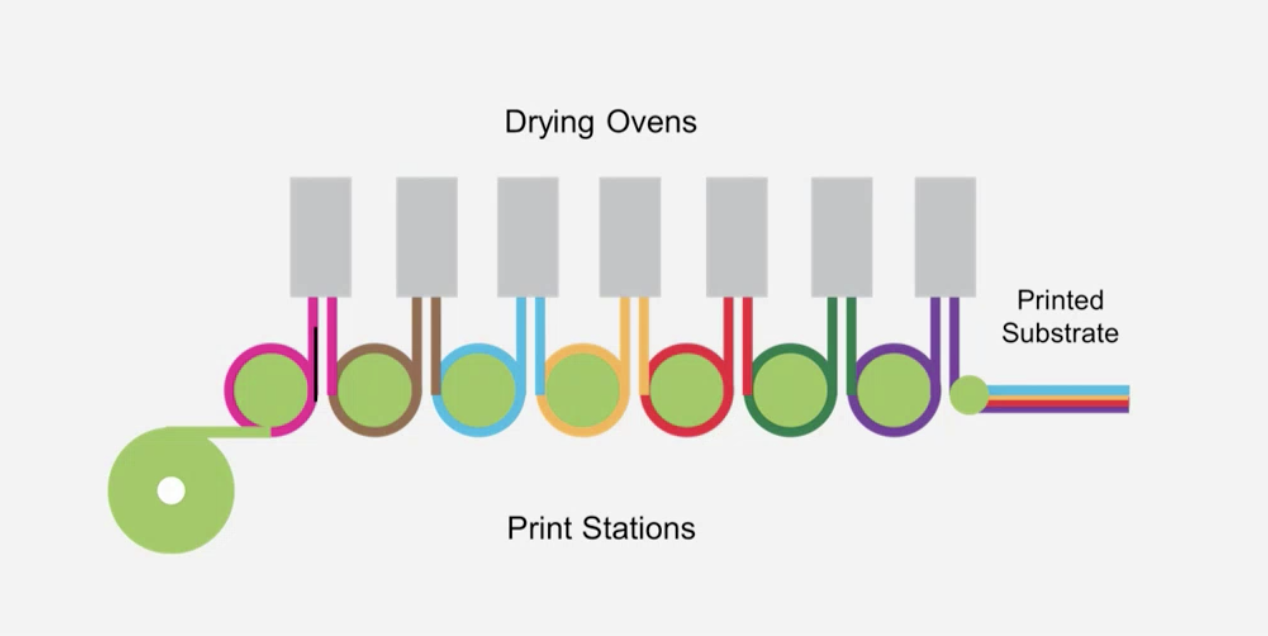
At each stage, multiple layers of color and pattern are added to create the final visual effect. The first stop might be the background color, the next might be the beveled edge for a woodgrain look, and gradually feature elements like knotholes or cathedral textures are added, continuing to build the beautiful woodgrain visual effect. Each layer builds on the previous one until the complete design emerges.
Next a wear layer is applied over the printed pre-gel layer. In Mannington Commercial products, this is our proprietary Quantum Guard Elite® polyurethane wear surface.
At this point, the entire product is passed through a texture roller to create a relief texture that complements the visual effect and provides additional performance attributes. The product then passes through a series of temperature-controlled ovens to cure the wear layer and finish the product.
If this seems like a lot of steps, it is. But that's exactly what's needed to achieve the rich visuals and superior performance that are so characteristic of Mannington Commercial products.
Homogeneous Construction
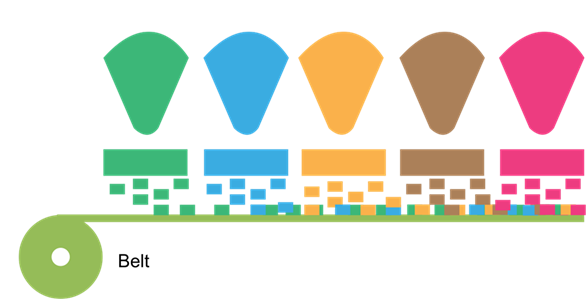
Homogeneous sheet products are single-ply products that are a mix of the same materials, but the product is not made in a single step. Homogeneous products begin with an industrial blender that mixes together specific chips of the color and size that are specific to that product.
The chips are then placed on a conveyor belt that moves the product through the process. If it were a homogenous sheet, the product would not have a printed image on it. Instead, the visual effect is created by the different combinations of chips. The way the chips are spread, the size and color of the chips, and the balance of the formula that holds and bonds the chips all affect the final visual and performance attributes of the product.