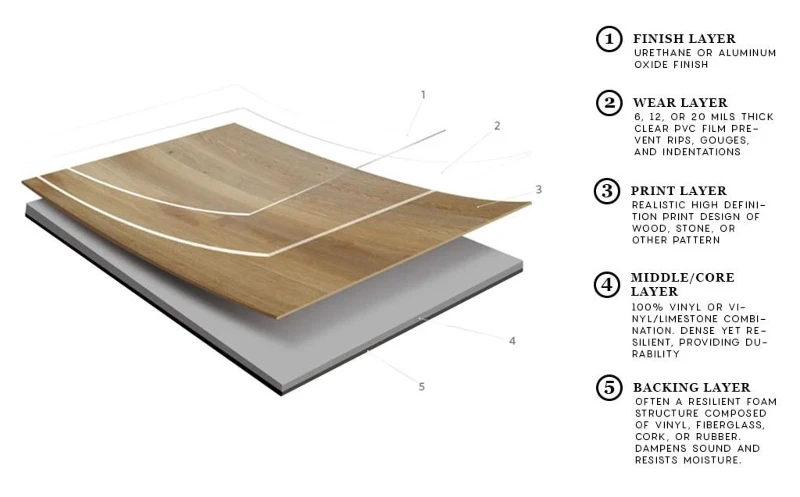

Grading Standards and Applications of Resilient Vinyl Flooring
The EN685 "Grading Standards for PVC Resilient Flooring Products" approved and implemented by the European Community strictly divides floors used in different areas into 3 standards:
⒈household grade standards: 21-23;
⒉commercial grade standards: 31-34;
⒊industrial grade standards: 41-43.
1. Technical performance requirements
1.1 Abrasion resistance: EN685 abrasion resistance is sorted by 21-22-23-31-32-41-33-42-34-43.
1.2 Color fastness: The determination of color fastness values is based on ISO 105-B02, generally 6 degrees and 7 degrees. The higher value means better color fastness and less chance to change color.
1.3 Anti-slip: The European standard BGR181 stipulates that the anti-slip grade of elastic materials should be between R9 and R11. The higher the grade, the better the anti-slip performance.
1.4 Residual indentation: represents the strength of the floor's ability to recover after being deformed by pressure. The smaller the value, the smaller the dent produced by the material after being compressed. Usually, homogeneous core-penetrating flooring are better than laminated flooring, and the residual indentation value of laminated hard backing flooring is better than that of foam backing vinyl flooring. European standard: error < 0.04 mm
1.5 Dimensional stability: EN434, GB/T4085-2005 and GB/T11982.1-2005 require the material heating length change rate (except linen) to be per pound; 0.40% for rolls per pound; 0.25% for sheets per pound.
1.6 Surface treatment: It can be divided into three types: full-body polyurethane (PUR) treatment, surface PUR treatment and no PUR treatment. The polyurethane is used to seal the pores between the molecules on the surface of the material and improve the anti-fouling performance.
1.7 Fireproof: According to the provisions of German DIN4102, American ASTM648 and national standard GB8624-1997, flooring materials should reach B1 level
2. Performance explanation and certification:
2.1. Sound insulation: The unit is dB (A), which is the result of subtracting the A sound level after insertion from the A sound level before sound insulation.
2.2. Thermal conductivity: Only when thermal insulation is required, test thermal conductivity, according to EN1339 or use the density-related values in EN12524.
2.3. Anti-slip: PVC elastic floor will produce instantaneous elastic deformation under local pressure and increase the friction coefficient of the floor, making it difficult to slip when walking. The surface of hard floor materials is hard and smooth, and its friction coefficient u is only 1/3 of PVC, making it easier to slip when walking.
2.4. CE certification: It means that the product meets a series of European indicators such as safety, hygiene, environmental protection and consumer protection of the European Community.
2.5, HQE (High Quality Environmental Building) is the evaluation system of the Building Research Establishment (BRE) in the UK, and the BREEAM system is the world's first green building evaluation system
2.6, EN649 can be divided into four levels according to the wear resistance level: T, P, M, F