

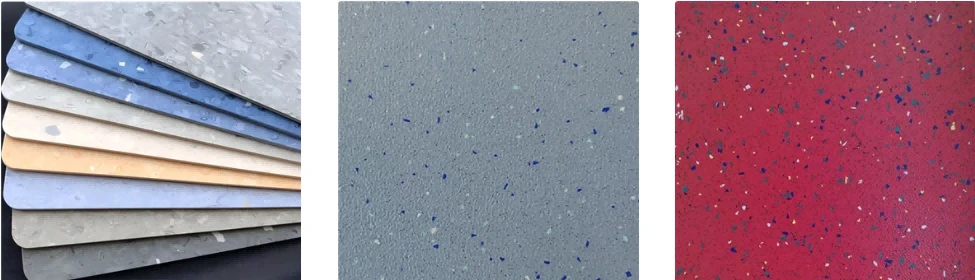
I. Introduction to industrial floor
Industrial floor is a prefabricated floor with polymer resin and fiber cloth (or mesh) as the main components, which is widely used in industrial manufacturing environment. It has the characteristics of corrosion resistance, chemical erosion resistance, dust-free, high wear resistance, easy cleaning, etc. It is an ideal floor material that meets the requirements of heavy-load and high-frequency working environment.
II. Overview of construction and paving system
Industrial floor construction involves a complete set of scientific and systematic paving processes, including base preparation, material pre-laying, cutting, bonding, rolling, splicing, welding and final delivery. Each link must be strictly implemented in accordance with the specifications to ensure the quality of laying and long-term durability.
III. Base and construction environment requirements
Before construction, the base should be strictly inspected and treated. The specific requirements are as follows:
1. Dryness: ground moisture content ≤4%; a moisture-proof layer is required on the first floor.
2. Strength requirements:
- Heavy load area ≥1.5 MPa;
- Light load area ≥1.0 MPa.
3. Flatness: Use a 2m ruler to check, the error is ≤2mm.
4. Surface condition:
- No pollution such as oil, dust, and isolation;
- No defects such as sanding, hollowing, cracks, and damage.
5. Environmental conditions:
- Air humidity 35%~75%;
- Temperature 10℃~30℃.
6. Leveling treatment: Secondary leveling is not recommended. When leveling is necessary, self-leveling materials that meet the requirements of compression, flexural resistance, and bonding strength should be used.
7. Gap repair: After V-shaped grooving, clean the seams, embed corrugated steel sheets, and pour epoxy resin for curing for more than 24 hours.
IV. Material preparation and pre-laying
1. The materials should be unrolled and cured for ≥48 hours at the construction site.
2. Position and lay out according to the design drawings, and use a marker to draw lines during pre-laying to ensure that they do not shift.
3. The floor pre-laying adopts the overlapping method, and the overlapping width is ≥20mm.
4. Before cutting, a margin of about 20mm should be reserved to ensure seamless splicing.
V. Glue scraping and paving
1. Adhesive ratio: Use M919 two-component polyurethane glue and stir for 2~3 minutes after mixing.
2. Glue scraping process:
- Use A3/B3 toothed scraper;
- The amount is controlled at 400~450g/㎡;
- The glue is evenly distributed to avoid scratches and hollows.
3. Glue drying requirements:
- Two-component polyurethane can be dried without drying;
- If drying is required, the time is controlled at 10~30 minutes, and it is OK if there is wire drawing when touched by hand.
4. Laying method:
- Position and lay along the reference line;
- Use a cork block to push the surface to exhaust and fit;
- Use a 50kg/75kg steel roller to roll evenly;
- Do not roll the overlapping edges of the floor temporarily to reserve cutting space;
- Use a small steel roller to assist in compaction at the corners;
- Wipe off the overflowed glue at any time to keep it clean.
VI. Joint cutting and welding treatment
1. Joint cutting:
- Use a special push knife or track cutter to cut the joint from the center of the overlap;
- The trimming work must be completed before the glue is completely cured;
- Immediately compact the seam after cutting. If there is warping, use a hot air gun or pressurized treatment.
2. Welding treatment (48 hours after the glue is cured):
- Use a special grooving tool to make grooves, the depth is about 2/3 of the floor thickness;
- The end area can be grooved with the assistance of manual tools;
- After cleaning the dust in the groove, choose according to the process:
- Cold welding: grooving → pasting masking paper → filling → scraping → tearing paper;
- Hot welding: welding gun temperature 350℃~450℃, welding rod semi-cooled and completely cooled, trim twice;
- For seamless splicing process, ensure that the joints are tight and straight.
VII. Cleaning and delivery
1. Cleaning the site: clean up all glue, waste, and debris, and transport them to the designated place for treatment.
2. Construction self-inspection: check the joints, welding quality, floor integrity, etc., and rectify any problems immediately.
3. Formal delivery: delivered for use after acceptance by the owner or supervision unit.
8. Acceptance Standards
Material acceptance:
1. Variety, specification, color and thickness meet the design requirements;
2. The surface should be free of color difference, cracks, wrinkles, vortices and other defects;
3. The floor surface is clean, free of foreign matter and impurities, and the size is qualified;
4. Each layer is firmly bonded, without warping, degumming or overflowing.
Quality requirements for finished products:
1. Appearance quality:
- The surface is clean and free of scratches and creases;
- The joints are flat, tight and free of glue marks;
- The wall edges are closed naturally, and the corners are square and smooth.
2. Weld quality:
- Flat and smooth, without coking, weld nodules or peeling;
- The height difference is ≤0.6mm.
3. Overall flatness:
- Surface flatness ≤3mm/2m;
- The height difference of the joints ≤0.5mm;
- The straightness deviation of the seam grid is ≤3mm.
4. Bonding firmness:
- There shall be no bulging, debonding, hollowing, edge warping, etc.
