

Industrial sites are different from commercial sites. Vehicle tires are frequently rolled over, and high requirements are placed on the installation system and floor. Vehicle tires are divided into pneumatic tires and solid tires. Pneumatic tires have lower requirements on the ground than solid tires.
Limited to the current status of cement-based self-leveling mortar in China, it is not recommended to construct cement-based self-leveling in industrial (traffic vehicle) environments. It is difficult for ordinary water-based interface agents to achieve a bonding tensile strength of 1.5Mpa. The interface agent must use a sandblasting process, and self-leveling must use products of C35 or above. The cost of self-leveling is extremely high, which is not conducive to the promotion of industrial floors. There are two methods of leveling, addition and subtraction. Self-leveling leveling is addition, and grinding leveling is subtraction (mostly seen in polished concrete). The most reasonable solution is to use large-area grinding leveling + local low-lying repair mortar leveling. Large-area grinding leveling starts with 30-mesh iron grinding discs and ends with 100-mesh resin sheets. T53 quick repair mortar is used to fill in the local area.
The selection of adhesive needs to consider the load. For pneumatic tires, choose an adhesive with high shear strength. The first choice is UZIN's latest product KE68 silane-terminated polyurethane adhesive, followed by T220, Thomsit's K188S, K150, and UZIN's KE66. For non-absorbent base layers, choose products of the T300 level. For areas where solid tires are used, it is recommended to choose KE68 or a two-component reactive adhesive.
For industrial environments where wheels scratch the floor surface, water-based polyurethane coating can be used to solve the problem.
In heavy-duty industrial environments, problems can occur quickly and seriously due to improper system configuration:
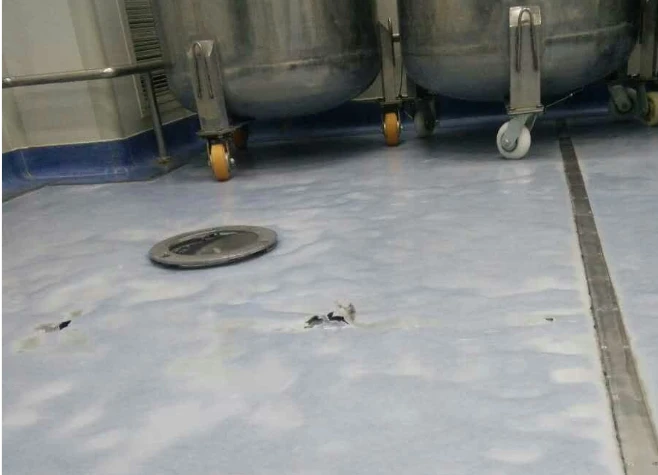
In light industrial environments, the requirements for installation systems are higher than those for commercial environments. Old floors are particularly renovated, and the base treatment cannot be taken lightly. The following are some photos of the construction process of industrial floors:
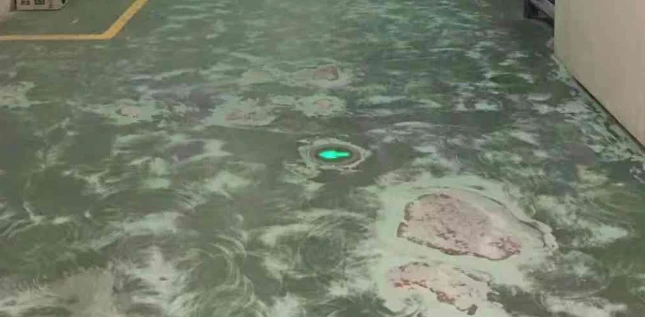
Base pretreatment
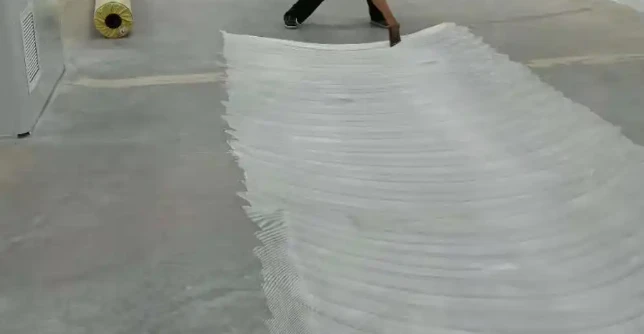
Glue scraping and pasting
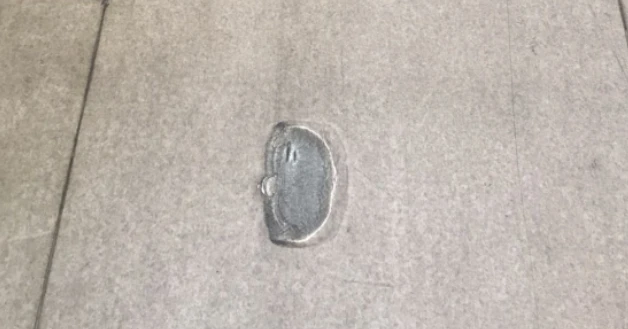
Industrial floors have high load-bearing capacity and high requirements for the floor itself. The above picture shows a heavy-duty forklift turning in place, and friction generates high temperature, and ordinary commercial composite coiled flooring is instantly melted. Ordinary commercial-grade floors are not suitable for industrial use, especially in places with higher loads.
